
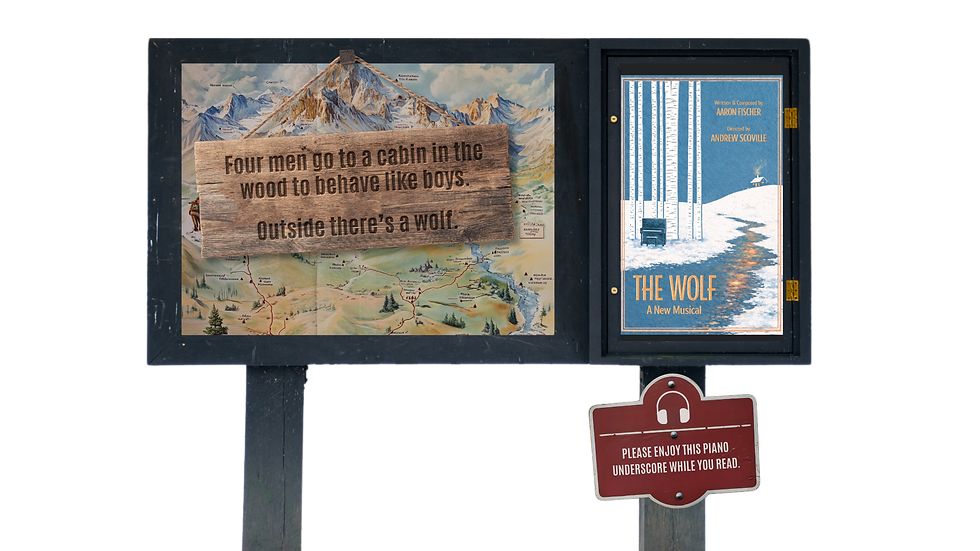
THE WOLF
A New Musical


A BITING NEW MUSICAL ABOUT BATTLING THE DARKNESS OUTSIDE… AND WITHIN.

THE PLAY



FOUR MEN: DONNY, EMMETT, PETER, and WYATT
ONE SOLO UPRIGHT PIANO
Four old friends meet for a weekend at a cabin in the woods to celebrate one of them finishing chemotherapy. Death is no match for a real man. They open beers, pour some shots and tell some stories. Boys being boys.
As the sun goes down, the host warns not to go outside after dark—there’s a wolf that’s been stalking the cabin at night. The others are uneasy about this… but since the point is staying inside and getting drunk anyway, they shrug it off.
The night gets punchy as drinks flow. Ego & masculinity begin to posture. Playful ribbing turns to bitter sniping. One of them feels especially picked on and hits his breaking point. To prove himself to the others, he finds a hunting knife and runs off to slay the wolf. He’ll prove his masculinity—in victory or death.
What happens next shocks them all.
THE
PIANO
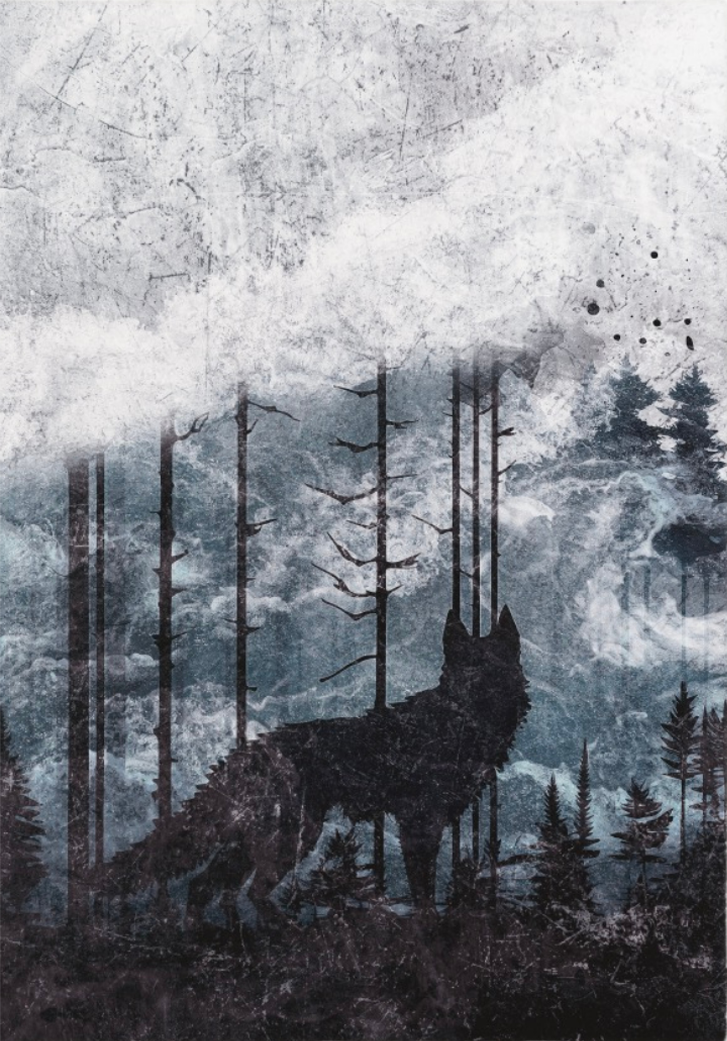
An upright piano sits downstage right, invisible to the men. The pianist acts as a silent narrator, telling a story with just his hands—fully present, aware of the audience watching him while he plays. As the show goes on it becomes clear: he is the wolf, and this is his story too.



The Play Outside the Play
Half the songs are the men cheerily in the cabin.
The other half exist as liminal moments, upward and out of time. They contrast the pastiche style in the cabin with poetic reflections of thirst, anger, regret… and acceptance.
In those songs especially, the wolf’s shadow looms large as the play’s spirit animal.

WHY WOLF?
Men at their core yearn to destroy themselves. This musical isn’t just four well-meaning friends becoming unraveled over a night of drinking. It’s an allegory for what men do when confronted with the ultimate enemy—themselves—and how their urge to destroy results in turning inward.
Inspired by the existentialism of Tom Stoppard’s Rosencrantz and Guildenstern Are Dead, the inevitability of Chekhov’s The Cherry Orchard, and the absurdity of Edward Albee’s The Goat, or Who is Silvia? …this musical takes the form as we know it and pushes to meditate on what men do to themselves.


AARON FISCHER (WRITER & COMPOSER)
Assistant to Jason Robert Brown in the 2000s (13: The Musical, Honeymoon in Vegas), creative assistant to John Kander from 2006-2016 (Curtains, All About Us, The Visit, Scottsboro Boys, The Landing), and music assistant to Henry Krieger thru the 2010s (The Flamingo Kid, Rebecca of Sunnybrook Farm, Side Show, Romantic Poetry and Monkey Show—both by John Patrick Shanley, Up in the Air, Dreamgirls at the Apollo). Most recently, he assisted Michael John LaChiusa on Gardens of Anuncia at Lincoln Center.
CONTACT: AaronFischer@me.com

ANDREW SCOVILLE (DIRECTOR)
Select credits include Have You Ever Thought About (Bushwick Starr), Theater of the Mind (DCPA and Goodman), Travels (Ars Nova), Money Heist: The Experience (NYC production with Netflix/Fever), The Brobot Johnson Experience (Bushwick Starr), Escape the Planet (NY Hall of Science commission with astronomer Moiya McTier). Associate director credits include: Here Lies Love (dir. Alex Timbers, Broadway, Public Theater, National Theater UK, Seattle Rep), Sweeney Todd (dir. Bill Buckhurst, Barrow Street Theater). He works as a Creative Director for immersive experiences with various creative studios. He teaches Advanced Directing and Playable Theater at Playwrights Horizons Theater School, NYU Tisch. Co-director Fresh Ground Pepper NYC.
WEBSITE: AndrewjScoville.com
CONTACT: AndrewjScoville@gmail.com

THE WOLF IS...

ANDREW SCOVILLE (DIRECTOR)
Select credits include Have You Ever Thought About (Bushwick Starr), Theater of the Mind (DCPA and Goodman), Travels (Ars Nova), Money Heist: The Experience (NYC production with Netflix/Fever), The Brobot Johnson Experience (Bushwick Starr), Escape the Planet (NY Hall of Science commission with astronomer Moiya McTier). Associate director credits include: Here Lies Love (dir. Alex Timbers, Broadway, Public Theater, National Theater UK, Seattle Rep), Sweeney Todd (dir. Bill Buckhurst, Barrow Street Theater). He works as a Creative Director for immersive experiences with various creative studios. He teaches Advanced Directing and Playable Theater at Playwrights Horizons Theater School, NYU Tisch. Co-director Fresh Ground Pepper NYC.
WEBSITE: AndrewjScoville.com
CONTACT: AndrewjScoville@gmail.com

AARON FISCHER (WRITER & COMPOSER)
Assistant to Jason Robert Brown in the 2000s (13: The Musical, Honeymoon in Vegas), creative assistant to John Kander from 2006-2016 (Curtains, All About Us, The Visit, Scottsboro Boys, The Landing), and music assistant to Henry Krieger thru the 2010s (The Flamingo Kid, Rebecca of Sunnybrook Farm, Side Show, Romantic Poetry and Monkey Show—both by John Patrick Shanley, Up in the Air, Dreamgirls at the Apollo). Most recently, he assisted Michael John LaChiusa on Gardens of Anuncia at Lincoln Center.
CONTACT: AaronFischer@me.com
THE WOLF IS...

DEMOS
Piano variations from the 11 o’clock number.
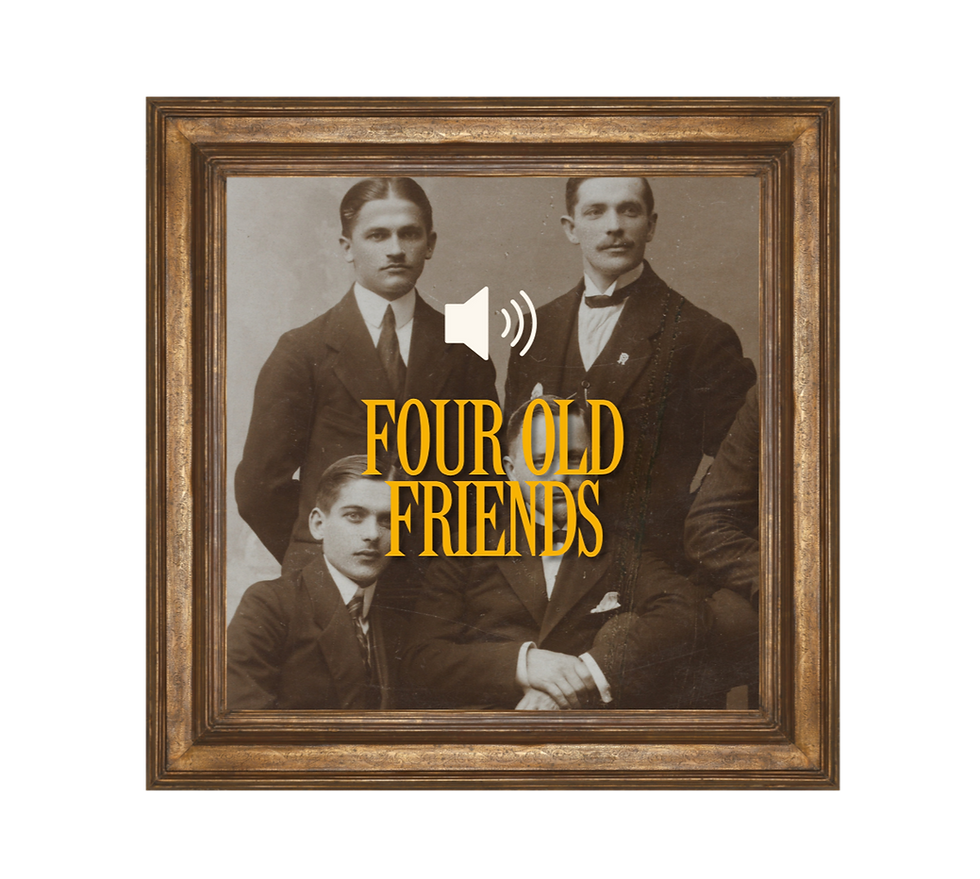
2. FOUR OLD FRIENDS (All 4 Men)
Opening
The pianist walks out at the beginning, sits and plays a note at the top of the piano. All four men enter and step forward.
3. THE MIST (Emmett)
Immediately following the opening number, EMMETT steps forward for a reflection on the loss of self.
4. ALWAYS COMES BACK (Emmett, All 4 Men)
Later when the guys ask EMMETT about cancer & chemo, he remarks that death comes for us all but he’s glad to beat it today. DONNY doesn’t like the macabre tone, so of course EMMETT pokes at him in song.
5. HOW I MISS THE MORNING (Donny)
In the middle of the show there is a furious trio of songs where the men in the cabin torment WYATT for being scared (“There’s a Wolf Outside”); following that suddenly the men step forward into a declaration stemming from the pianist about bar-fighting (“Stare the Man Down”); once all that aggression is out of everyone’s system, DONNY steps forward quietly for a reflection on time gone by.
6. I WAS THERE (Wyatt, All 4 Men)
We’re nearing the climax and WYATT has had enough of being picked on. But before taking matters into his own hands, he makes one last desperate attempt at convincing the others of his prowess. His friends respond by treating his story as the ravings of a lunatic, adding their own favorite conspiracies to the conversation. WYATT, sufficiently driven mad, grabs a knife at the song’s end.

DEMOS
Piano variations from the 11 o’clock number.
2. FOUR OLD FRIENDS (All 4 Men—Opening)
The pianist walks out at the beginning, sits and plays a note at the top of the piano. All four men enter and step forward.
3. THE MIST (Emmett)
Immediately following the opening number, EMMETT steps forward for a reflection on the loss of self.
4. ALWAYS COMES BACK (Emmett, All 4 Men)
Later when the guys ask EMMETT about cancer & chemo, he remarks that death comes for us all but he’s glad to beat it today. DONNY doesn’t like the macabre tone, so of course EMMETT pokes at him in song.
5. HOW I MISS THE MORNING (Donny)
In the middle of the show there is a furious trio of songs where the men in the cabin torment WYATT for being scared (“There’s a Wolf Outside”); following that suddenly the men step forward into a declaration stemming from the pianist about bar-fighting (“Stare the Man Down”); once all that aggression is out of everyone’s system, DONNY steps forward quietly for a reflection on time gone by.
6. I WAS THERE (Wyatt, All 4 Men)
We’re nearing the climax and WYATT has had enough of being picked on. But before taking matters into his own hands, he makes one last desperate attempt at convincing the others of his prowess. His friends respond by treating his story as the ravings of a lunatic, adding their own favorite conspiracies to the conversation. WYATT, sufficiently driven mad, grabs a knife at the song’s end.




© 2026 by Aaron Fischer. Designed by Shelby Mullin.